


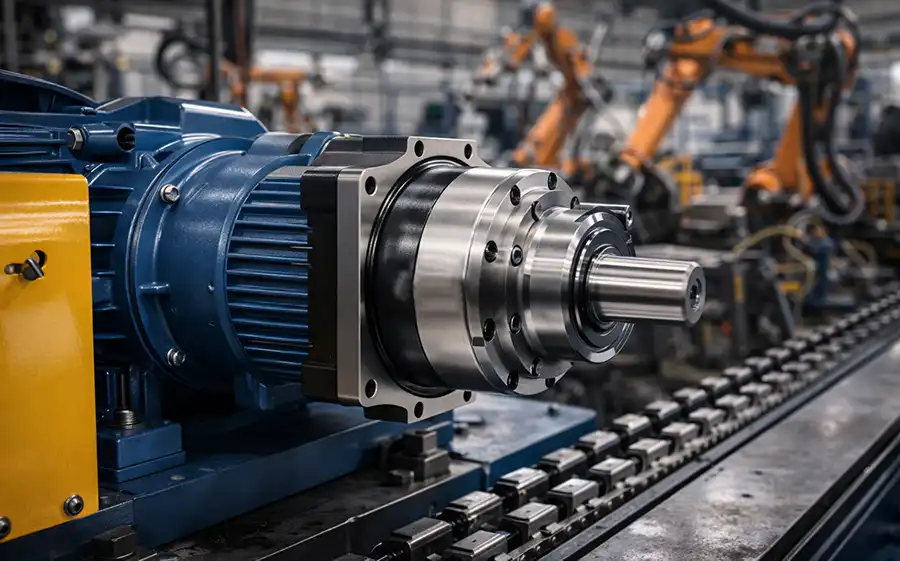
Planetary Reducer
Before giving information about planetary reducers, it is necessary to touch on what a reducer is. Reducers are, in the simplest terms, mechanical power transmission elements. While transmitting the motor power to the machine to be operated, they also reduce the rotation speed of the motor (depending on the rotation ratio) and obtain high torque. In this way, a small motor can operate a large machine or an industrial facility.
In other words, a reducer is a gear box system that converts the high-speed rotational motion coming from a motor or similar power source into a lower speed but higher torque in mechanical systems. It is generally used to reduce speed and increase torque in places where motor power is transferred. Thanks to its internal structure adjusted according to different gear ratios, it optimizes the power transferred to the output shaft.
There are various types of reducers in terms of purpose and capacity according to industrial applications.
- Worm gear reducers
- Helical gear coaxial type reducers
- Bevel gear reducers
- Parallel shaft reducers
- Planetary reducers
What is a Planetary Reducer?

In the simplest and shortest way, planetary reducers are the type of reducers with the highest torque capacity. In helical or bevel gear reducers, torque transmission occurs from a single point where one gear contacts another. Therefore, the larger the torque to be transferred, the larger the size of the gear must be. Enlarging the gears means enlarging the entire body of the reducer.
In planetary reducers, torque transmission is provided not through a single contact surface, but through at least 3 planetary gears that contact each other at the same time, so higher torque transmission can be achieved with relatively smaller gears.
Planetary Reducer Working Principle
In fact, the most accurate answer to the question of what is a planetary reducer can be given by explaining the working principle of planetary system reducers. Planetary reducers consist of a combination of separate planetary stages. One stage of a planetary reducer consists of a sun gear, planetary gears (3 or 4 pieces), a ring gear and a planet carrier plate.
The motion coming from the motor is first transferred to the sun gear connected to the motor shaft, then to the planet gears rotating around the sun gear and to the ring gear via the planet gears. In systems where the ring gear is kept fixed, the rotation motion is transferred to the next stage with the planet carrier plate. The desired conversion ratio is obtained by increasing the number of stages connected to each other.
Thus, higher torque transfer is provided in much smaller volumes compared to other types of reducers. In addition, the design of the machine to be operated is also made more compact thanks to this.
Areas of Use of Planetary Reducers
Planetary reducers have a wide range of uses in the industry since they are modular, i.e. have stages that can be added and removed, and input and output options. Planetary reducers are used in many areas from the energy sector to the cement and iron and steel industry, from mining to the maritime sector.
Installation of Planetary Reducers
In planetary reducers, there are shaft options that can meet different connection needs in the connection part to the machine, i.e. in the output part of the reducer. These are; options such as keyed solid shaft, splined solid shaft, splined sleeve shaft, shrink disc sleeve shaft.
If a coupling or pulley connection is desired between the planetary reducer and the motor, there is an input shaft option, and if a direct motor coupling is desired, there is a motor adapter connection set option. Planetary reducers are also very practical and have many options in terms of assembly. Foot, flange, body, shaft connection options are available for each body. During assembly of the reducer to the machine, care should be taken to ensure that the machine shaft and the motor shaft, and therefore the reducer shaft, are on the same axis.
No matter how difficult the working conditions are, planetary reducers that have been selected correctly, have been approached meticulously for assembly, and have complied with operating and maintenance instructions can provide very long-lasting operation.

When selecting a planetary reducer, considerations should be made
The motor power and speed required by the machine should be determined and a suitable motor with the capacity to provide the required power should be selected. The required torque will be obtained from the required power and speed using the formula T=9550*P/n2. After determining the required torque, the output torque of the reducer should be determined by multiplying the required torque with the service factor coefficient determined for the application in which the machine will be used.
The reducer body that provides the reducer output torque should be selected and the input and output options should be determined. After determining the motor connection side and machine connection side options, it should be checked whether the oil in the reducer will heat up or not. This control is called thermal capacity control. Thermal capacity varies for each reducer body according to the input speed, mounting position and ambient conditions.
Cooling equipment should be added for reducers with insufficient thermal capacity.
Cooling can be provided by placing a fan on the input shaft according to the cooling requirement, and in case of insufficient cooling, external cooling units should be selected and added to the reducer as an additional accessory.
To get more detailed information about planetary reducer types and planetary reducer prices, just call DARK PLANET.